Document Template Designer
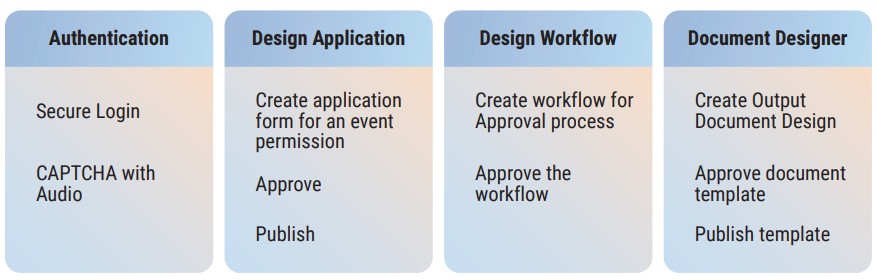
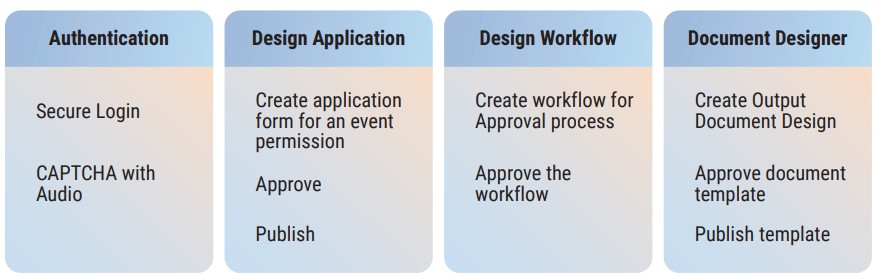
Government communication must be precise, uniform, and timely. The Document Template Designer module automates the creation of official letters, notices, proceedings, and approvals, saving significant manual effort.
Much like an enhanced mail merge system, it merges applicant data dynamically into standardized templates.
- Automated Document Generation: Instantly produces memos, permissions, or notices
- Uniformity in Format: Maintains standard design and structure across departments
- Error Reduction: Minimizes manual input and potential inaccuracies
- Reusability: Templates can be updated and reused across multiple workflows
This module ensures that official communications are consistent, professional, and instantly available once a decision is made.
Key Features
The PMS integrates powerful features that enhance usability, transparency, and control at every level of governance:
- Online, Anytime Access: Citizens can submit permission requests online, supported by mobile-friendly interfaces, Aadhaar/PAN integration, payment gateways, and reusable sub-forms
- Real-Time Notifications: Automated SMS and email alerts keep applicants and officials informed at every stage of processing
- Role-Based Access Control: Ensures that users from clerical staff to senior officers only see information relevant to their roles
- Comprehensive Tracking: Applicants can monitor status updates, while officers can access remarks, attachments, and notices through a single interface
- Configurable Workflows: Allows parallel processing, iterative clarifications, and per-stage configurations like remarks, digital signatures, or payments
- Document and Feedback Management: Enables secure document uploads and captures post-event feedback for continuous improvement
- Advanced Analytics and Reports: Generates role-wise, time-wise, and form-wise analytics to identify process bottlenecks and improve efficiency
- Legacy Onboarding: Supports the digitization and renewal of permissions issued previously through offline systems, ensuring inclusivity in digital transformation
Permissions Covered
The PMS currently supports more than 20 categories of permissions, including:
- Public and private events
- Film and ad shootings (road and off-road)
- Marathons, rallies, and charity walks
- Blasting permissions and renewals
- Loudspeaker and sound system use
- Establishment licenses and renewals
- Event cancellations, modifications, and post-event feedback
Each category can be configured independently, giving administrators complete control over form design, workflows, and approvals.
Measurable Impact in Cyberabad
Since its rollout, the Permissions Management System has brought a measurable transformation in how public applications are processed in Cyberabad.
- Processing Time Reduced: Automated workflows have cut average approval time from several days to just a few hours
- Transparency Enhanced: Citizens can track applications online, and officials benefit from audit trails and real-time data visibility
- Convenience for Citizens: Paperless applications, digital payments, and instant updates save time and eliminate the need for physical visits
- Administrative Agility: During major events such as festivals or marathons, new forms and workflows can be deployed instantly
- Scalability and Adoption: The system’s success led to its adoption by the Hyderabad and Rachakonda Police Commissionerates, demonstrating its scalability and ease of replication
A notable example was during the festival season, when thousands of pandal and event permissions were processed smoothly and on time, proving the system’s resilience under peak load.
Conclusion
The Permissions Management System represents more than an administrative upgrade it marks a shift towards adaptive, intelligent, and citizen-focused governance.
By combining configurability, automation, and transparency, the PMS reduces dependency on developers, minimizes manual errors, and accelerates decision-making.
It is not limited to policing; its modular design makes it replicable across government departments from municipal corporations to education boards and environmental agencies.