


Page 44 - Informatics, April 2022
P. 44
International eGov Update


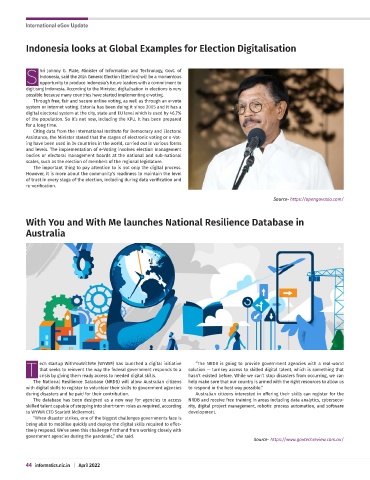
          Indonesia looks at Global Examples for Election Digitalisation


              hri Johnny G. Plate, Minister of Information and Technology, Govt. of
              Indonesia, said the 2024 General Election (Election) will be a momentous
          S opportunity to produce Indonesia’s future leaders with a commitment to
          digitising Indonesia. According to the Minister, digitalisation in elections is very
          possible because many countries have started implementing e-voting.
            Through free, fair and secure online voting, as well as through an e-vote
          system or internet voting. Estonia has been doing it since 2005 and it has a
          digital electoral system at the city, state and EU level which is used by 46.7%
          of the population. So it’s not new, including the KPU. It has been prepared
          for a long time.
            Citing data from the International Institute for Democracy and Electoral
          Assistance, the Minister stated that the stages of electronic voting or e-Vot-
          ing have been used in 34 countries in the world, carried out in various forms
          and levels. The implementation of e-Voting involves election management
          bodies or electoral management boards at the national and sub-national
          scales, such as the election of members of the regional legislature.
            The important thing to pay attention to is not only the digital process.
          However, it is more about the community’s readiness to maintain the level
          of trust in every stage of the election, including during data verification and
          re-verification.
                                                                                            Source- https://opengovasia.com/


          With You and With Me launches National Resilience Database in
          Australia


              ech startup WithYouWithMe (WYWM) has launched a digital initiative   “The NRDB is going to provide government agencies with a real-world
              that seeks to reinvent the way the federal government responds to a   solution — turnkey access to skilled digital talent, which is something that
          T crisis by giving them ready access to needed digital skills.   hasn’t existed before. While we can’t stop disasters from occurring, we can
            The National Resilience Database (NRDB) will allow Australian citizens   help make sure that our country is armed with the right resources to allow us
          with digital skills to register to volunteer their skills to government agencies   to respond in the best way possible.”
          during disasters and be paid for their contribution.    Australian citizens interested in offering their skills can register for the
            The database has been designed as a new way for agencies to access   NRDB and receive free training in areas including data analytics, cybersecu-
          skilled talent capable of stepping into short-term roles as required, according   rity, digital project management, robotic process automation, and software
          to WYWM CTO Scarlett McDermott.                      development.
            “When disaster strikes, one of the biggest challenges governments face is
          being able to mobilise quickly and deploy the digital skills required to effec-
          tively respond. We’ve seen this challenge firsthand from working closely with
          government agencies during the pandemic,” she said.
                                                                                     Source- https://www.govtechreview.com.au/


          44  informatics.nic.in  April 2022

