AI-Based Face Search Transforming Archives with Facial Search Intelligence

Transforming Archives with Facial Search Intelligence

Face search technology uses AI to identify and match faces across large photo collections. It extracts unique facial features from an image and compares them with stored data to find matches-regardless of lighting, angle, or expression. It enables fast, photo-based search without relying on names or dates.

The President’s Secretariat maintains an extensive repository of photographs taken during official events held at Rashtrapati Bhavan and across various tours and engagements of the Hon’ble President of India. These images, captured by official photographers, document state functions, ceremonial occasions, and national milestones. Over time, this has resulted in the creation of a vast digital photo archive, a portion of which is publicly accessible through the Digital Photo Library (DPL) portal (https://dpl.rashtrapatibhavan.gov.in/) .

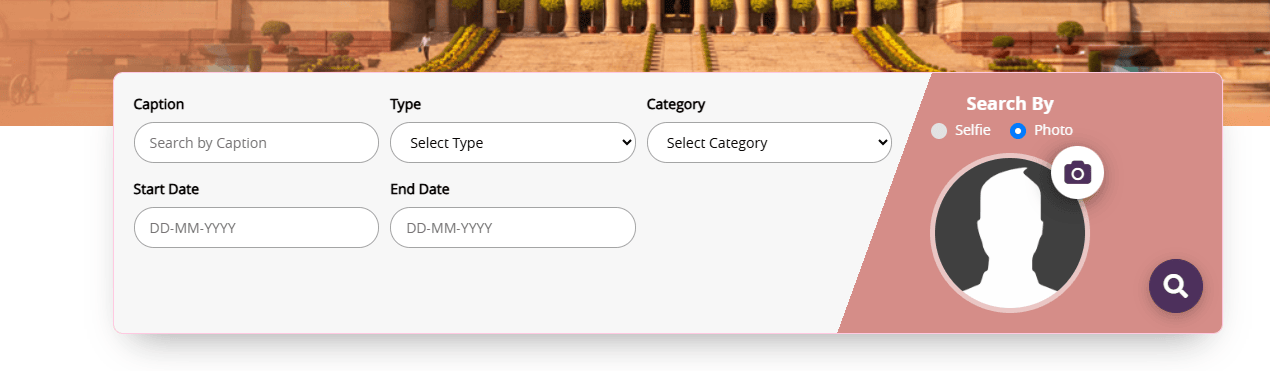
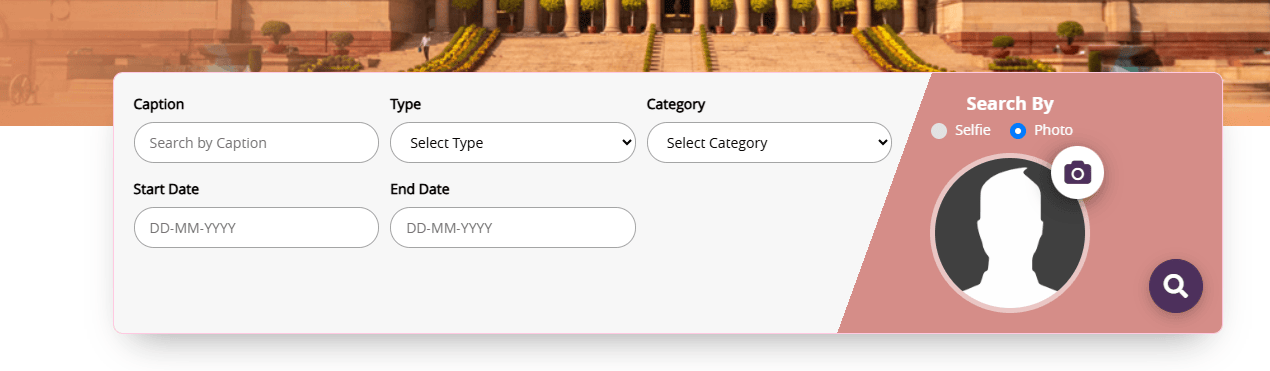
While metadata-based search (by event, date, or keywords) is available, it becomes increasingly difficult to locate specific individuals across different events—especially when the user does not recall the event name or date. To address this, an AI-powered FaceSearch service has been introduced. This system enables users to search for photos by uploading a photo or taking a selfie, allowing facial recognition to identify images containing the same individual across the archive.
The Need for an AI-Driven Solution

Whenever the Hon’ble President participates in an event—be it at Rashtrapati Bhavan or during a state visit—the official photographer documents the occasion in detail. These photos are systematically uploaded to the Digital Photo Library. However, the need often arises to locate photographs of a specific person across multiple events. Without knowing the exact event name, date, or other metadata, finding such images through traditional filters can be time-consuming and ineffective.

Face-based search offers a more intuitive solution: by simply uploading an image, the system can identify and retrieve all photographs in which that person appears, regardless of the event context.

Background on Facial Recognition Technology

The core of the FaceSearch system lies in AI-based facial recognition, which uses deep learning models—primarily convolutional neural networks (CNNs)—to analyze and compare faces.

The facial recognition process involves:

  • Face Detection: Identifying and isolating fac es from the background in an image
  • Feature Extraction: Generating unique facial embeddings—numerical vectors that represent the distinctive features of each face
  • Similarity Matching: Comparing embeddings using cosine similarity or other metrics to de termine how closely they match

These techniques have evolved to handle challenges such as changes in lighting, facial angles, age progression, or expressions, making them highly effective for large-scale photo retrieval.

System Architecture and Technical Details

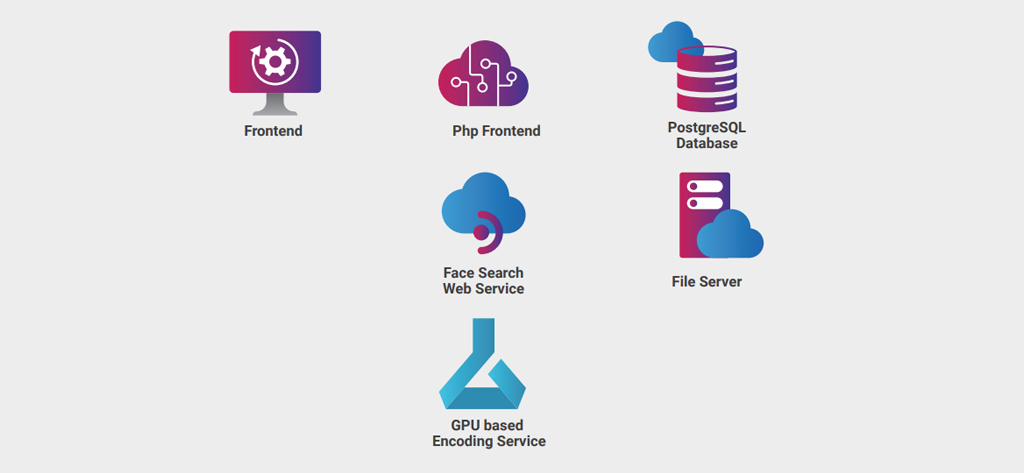
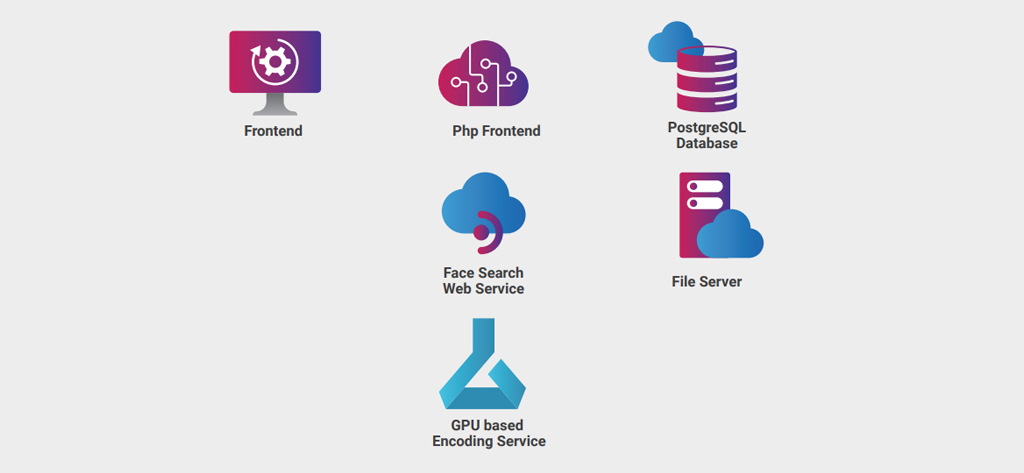
The FaceSearch functionality has been integrated into the Digital Photo Library platform with a modular, scalable architecture comprising the following components:

Digital Photo Library Platform

  • Frontend and Backend: Developed using PHP and PostgreSQL
  • Photo Storage: Images are stored in a secure file system; metadata is stored in PostgreSQL

FaceSearch System

The facial recognition system is built in two layers:

  • FaceSearch Web API:
    • Built using FastAPI (Python)
    • Manages incoming requests (image uploads), interfaces with the database, and communi cates with the GPU-based encoding service
    • Stores image encodings and metadata linkages
  • Face Encoding Service
    • Deployed on a GPU server
    • Performs the facial feature extraction using pre-trained deep learning models
    • Returns encodings to the Web API for stor age and comparison
The search panel for DPL showing the face search module The search panel for DPL showing the face search module Fig 12.1: The search panel for DPL showing the face search module

Workflow

Image Upload & Storage
  • A user uploads a photo to DPL or captures a selfie
  • Metadata is stored in PostgreSQL
  • The image is stored in the file system and sent to the FaceSearch API
Encoding & Matching
  • The API sends the image to the GPU-based encoding service
  • The encoding service extracts facial features and returns a vector
  • This vector is stored alongside the photo metadata
  • When a search is initiated with a photo, the uploaded image is similarly encoded
  • The system compares the query embedding with those in the database (filtered by other criteria like date/event)
  • Matches are returned to the user, showcasing relevant photos
System Diagram System Diagram Fig 12.2: System Diagram

Key Features

Selfie and Photo-Based Search

Users can find photos using an image instead of relying on metadata.

Advanced Filtering

Supports traditional filters like event name, date range, and keywords.

Fast, Scalable Performance

GPU-backed encoding and efficient search mechanisms ensure quick results.

Secure and Modular Design

Separation of services ensures maintainability and scalability.

Future Enhancements

To further enhance the system’s capability and user experience, the following improvements are proposed:

Multi-Face Search

Enable simultaneous recognition of multiple faces within a single photo, useful for group photos.

Improved Facial Recognition Models

Continuously retrain the AI model using more diverse and up-to-date datasets to handle age variations, occlusions (like masks), and lighting differences more accurately.

Face Clustering and Similarity Grouping

Automatically group similar faces across the dataset using clustering algorithms to assist archivists and researchers.

Natural Language-Based Search

Integrate natural language processing (NLP) to support conversational queries like “Show all events with foreign dignitaries in 2024.”

Text-Image Multimodal Search

Use Multimodal Large Language Models (LLMs) to enable image retrieval based on text descriptions, Use Multimodal Large Language Models (LLMs) to enable image retrieval based on text descriptions,

Conclusion

The integration of AI-powered facial recognition into the Digital Photo Library PostgreSQL Face Search GPU based marks a significant step toward modernizing archival access and enriching user experience. By allowing intuitive, image-based searches, the system not only enhances accessibility but also opens up new possibilities for historical research, documentation, and public engagement.

The journey ahead involves making the system smarter, faster, and more inclusive— ensuring that this national visual archive continues to serve as a living chronicle of the Presidency and the people of India.

Contact for more details

Sayantan Saha

Scientist - D
President’s Secretariat, Rashtrapati Bhavan, 
President’s Estate, New Delhi - 110004

Share

FacebookLinkedinTwitter

Also read

Government Democratizes Chip Design Access Across Indian Universities

The Government of India is accelerating the democratization of semiconductor design and in…

Read more

Passport Verification Record Now Available on DigiLocker for Citizens…

The National e-Governance Division (NeGD) under the Ministry of Electronics and Informatio…

Read more

Strategic Alliance to Fast-Track India’s Next-Gen Defence Technologies

In a major step towards advancing self-reliance in defence technologies, the Indian Instit…

Read more

AI/ML-Based Applications Set to Transform India’s Power Sector

Artificial Intelligence (AI) and Machine Learning (ML) based applications will play a pivo…

Read more

Smart AI Traps: A New Weapon in the War Against MosquitoBorne Diseases

I n a leap forward for global health surveillance, scientists are now turning to artificia…

Read more

US Lawmakers Move to Ban Chinese AI in Federal Agencies

Abipartisan group of U.S. lawmakers has introduced the No Adversarial AI Act, seeking to b…

Read more

United States Begin Using AI to Review 911 Calls

Across the United States, county governments are increasingly turning to artificial intell…

Read more

Beyond the Audit: ISO 27001 as the Backbone of Trusted Digital Infrastructure

India’s expanding digital governance needs more than routine audits, which often miss infr…

Read more

Cyber Hygiene at Scale: Securing Government LAN and Endpoints using MOGLES & CAAR

To address the complex cybersecurity needs of government infrastructure, a custom framewor…

Read more

DG NIC Honored with ‘Digital Champion’ Award at Tech Sabha 2025

At the prestigious Tech Sabha 2025, Shri IPS Sethi, Director General, NIC was conferred wi…

Read more