mini-U Government URL Shortening Service

mini-U

mini-U is a secure, government-approved URL shortening service developed by NIC, MP, to support large-scale e-Governance communication. It converts long official government URLs into compact, shareable links, helping reduce SMS costs, improve message readability, and enable efficient use of dynamic, scanner-friendly QR codes. Integrated with JanParichay for secure authentication and offering REST APIs for seamless system integration, mini-U provides a reliable, cost-effective, and scalable solution for government portals and applications that communicate with citizens at scale.

Large-scale e-Governance applications routinely disseminate information through SMS to citizens and businesses—covering application status updates, service notifications, advisories, and public announcements. These SMS messages frequently contain URLs that direct recipients to government portals for detailed information.

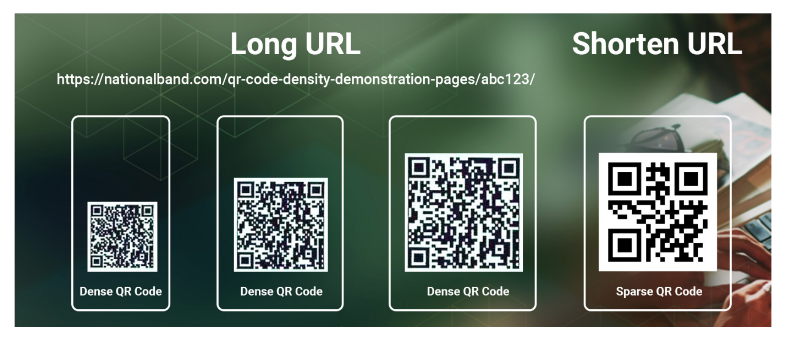
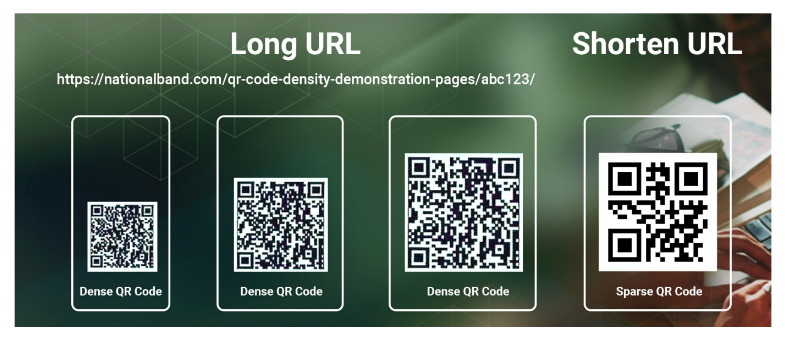
However, long URLs increase message length, inflate SMS costs, reduce readability, and lead to dense QR codes when used in printed materials.

mini-U is a secure, government-owned URL shortening service developed by NIC, MP, to address these challenges. It converts long official government URLs into short, shareable links while ensuring trust, security, and centralized governance.

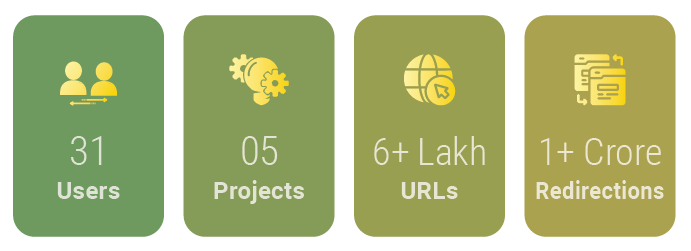
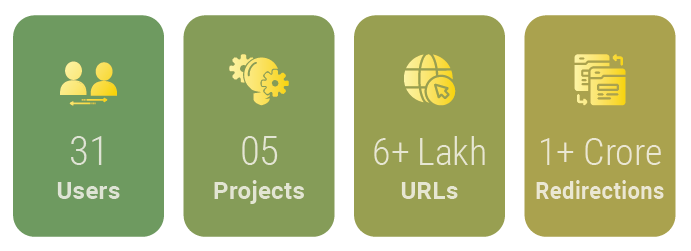
The service is already operational and successfully implemented across multiple government portals.

Why mini-U Matters for Digital Governance

Government departments send millions of SMS messages every year. Since SMS billing is directly linked to character count, even a small reduction in message length can result in significant recurring public savings.

mini-U addresses this systemic inefficiency by providing:

  • Cost optimization at scale
  • Improved citizen experience
  • Secure and standardized URL shortening
  • Better support for QR-based information delivery

It demonstrates how a focused digital utility can deliver outsized impact across governance systems.

Objective

The primary objectives of mini-U are to:

  • Reduce SMS costs for government applications
  • Improve clarity and readability of messages
  • Enable dynamic, durable, and scanner-friendly QR codes
  • Provide a trusted alternative to public URL shorteners
  • Ensure URLs originate only from verified government domains

To maintain authenticity and security, mini-U supports URL shortening exclusively for:

  • .gov.in
  • .sansad.in
  • .nic.in

How mini-U Is Useful

1. Cost Savings in SMS Communication

Government SMS gateways charge based on message length. Long URLs often push messages into multiple SMS units, multiplying costs.

By replacing long URLs with short mini-U links, applications can frequently reduce a two-SMS message to one.

Illustration: SMS Optimization

Original SMS

(214 characters → 2 SMS units)

Tune in to 108th Episode of Mann Ki Baat by Prime Minister Narendra Modi on 31st December 2023 at

https://www.mygov.in/talk/tune-108th-episode-mann-ki-baat-prime-minister-narendra-modi-31st-december-2023/-MyGov

SMS with mini-U Short URL

(133 characters → 1 SMS unit)

Tune in to 108th Episode of Mann Ki Baat by Prime Minister Narendra Modi on 31st December 2023 at

https://miniu.nic.in/MyGov-mju22jn

Note: Links are for illustration purposes only.

URL Transformation Example

Original URL: https://nicforms.nic.in/enRhYmxlNjg3OGQwYzEzMGJlZTIwMjUwNzE3MzY2

Shortened URL: https://miniu.nic.in/OJRMUx

2. Cleaner and More Reliable QR Codes

QR codes are widely used on banners, pamphlets, signboards, forms, and public notices. The length of the embedded URL directly affects QR code density and scannability.

Short URLs generated by mini-U result in sparse QR codes that are easier to scan and more durable.

Static vs Dynamic QR Codes

  • Static QR Code: Destination URL cannot be changed once printed
  • Dynamic QR Code (via mini-U): Destination URL can be updated without changing the printed QR

Advantages of Using mini-U for QR Codes

  • One printed QR code can point to updated content over time
  • Less dense QR codes improve scan success
  • No need for high-definition printing
  • Better readability even if faded, folded, or damaged
  • Ideal for outdoor and mass-printed materials

Security and Trust Framework

Unlike commercial URL shorteners, mini-U is designed specifically for government use. Key security and governance features include:

  • URL shortening restricted to verified government domains only
  • Centralized ownership and management by NIC
  • Protection against malicious redirection and phishing
  • Controlled issuance of API keys
  • Auditability and accountability for all integrations

This ensures citizen trust and safeguards official communication channels.

Common Use Cases

mini-U can be effectively used across multiple governance scenarios, including:

  • Application status updates (certificates, pensions, scholarships)
  • Election-related notifications and advisories
  • Health, disaster, and public safety alerts
  • QR codes on hospitals, offices, forms, and signboards
  • Government campaigns, hoardings, and advertisements
  • Digital forms and acknowledgements
How mini-U Works (High-Level Flow)

  • URL Submission: A government application submits a long, official URL to mini-U.
  • Short Link Generation: mini-U creates a secure, unique short URL mapped to the original link.
  • Multi-Channel Distribution: The short URL is embedded in SMS, notifications, emails, and QR codes.
  • Citizen Access: Citizens click the link or scan the QR code.
  • Secure Redirection: mini-U validates the request and instantly redirects users to the original government page.
ls-url ls-url

Technology Stack

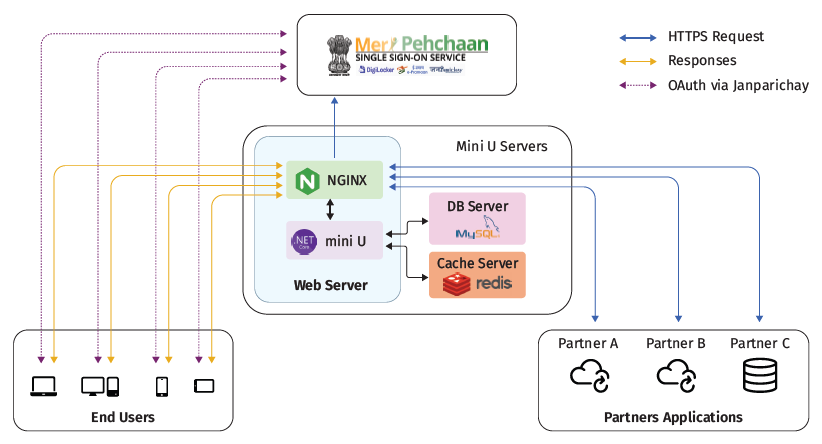
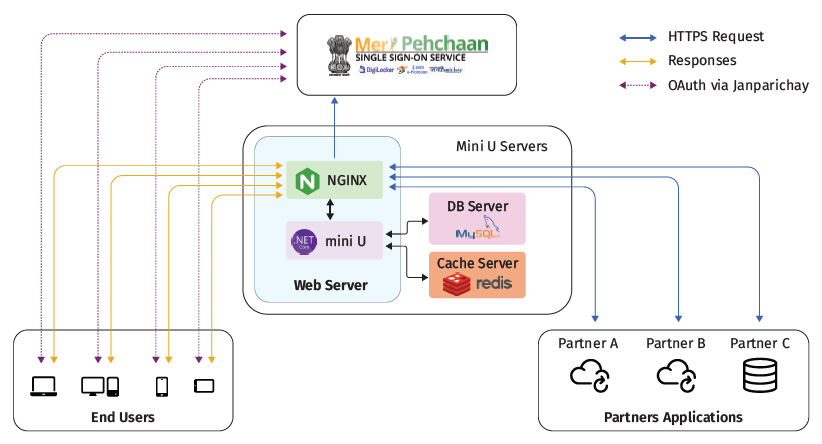
mini-U is built using modern, scalable technologies:

  • Backend: .NET Core
  • Frontend: Angular
  • Database: MySQL
  • Caching & Performance: Redis
  • Authentication: JanParichay (Single Sign-On)
mini-U Application Architecture mini-U Application Architecture Fig: 8.1 mini-U Application Architecture

User Authentication & Onboarding

mini-U follows a **secure, standardized, and government-approved onboarding process** to ensure that only authorized users and official initiatives can access its services. Authentication and access control are implemented through **JanParichay**, the Government of India’s Single Sign-On (SSO) platform.

Individual Government Users

Individual officers and employees of government organizations can directly access the mini-U portal for manual URL shortening through a secure login process.

Authentication Mechanism

Authentication is provided exclusively through **JanParichay Single Sign-On (SSO) Users must already be registered on JanParichay using an official government email ID.

Eligible Email Domains

Access is restricted to users with verified government domains, including:

  • @gov.in
  • @nic.in
  • @xx.gov.in (State and departmental domains)

Government Projects / Portals

For large-scale, automated, or system-level usage, mini-U provides API-based access to government projects and portals through a formal onboarding process.

mini-U in Action mini-U in Action Fig: 8.2 mini-U in Action

Onboarding Process

  • Designation of Representative: Each project or portal nominates an official representative. The representative must be registered on JanParichay using an eligible government email ID
  • Portal Registration: The representative signs up on the mini-U portal using JanParichay credentials
  • Submission of Onboarding Form: The prescribed onboarding form is filled with project details, intended usage, and technical requirements
  • Formal Request Submission: The completed form is emailed to: nicgrc-dev@mp.gov.in
  • Approval and Access Provisioning: The mini-U team seeks approval from the competent authority

Upon approval, the project is issued:

  • Secure API access keys
  • Detailed API documentation
  • Integration guidelines and usage terms

Onboarding Portal

https://miniu.nic.in/onboard

Key Benefits of This Approach

  • Ensures only authenticated government users can access the service
  • Maintains security, accountability, and auditability
  • Prevents misuse or unauthorized URL generation
  • Enables seamless scaling from individual use to enterprise-level integration

In essence, mini-U’s onboarding framework balances ease of access for government users with strict security controls, making it suitable for both individual officers and mission-critical government portals.

REST API Integration

mini-U provides REST APIs for large-scale, automated use by government applications.

API Benefits

  • Industry-standard REST architecture
  • Secure access via API keys
  • Seamless integration with SMS gateways and notification engines
  • Automated, high-volume URL generation
  • Improved performance through caching

Who Can Use mini-U

mini-U is designed as a shared national digital utility and can be adopted by a wide range of government stakeholders involved in citizen communication, service delivery, and public information dissemination. Its scope spans across administrative levels and functional domains, ensuring uniformity and efficiency in official digital communication.

  • Central Ministries and Departments
  • State Governments
  • District Administrations
  • NIC-developed portals and services
  • Government missions and campaigns

Conclusion

mini-U exemplifies how small, well-governed digital utilities can deliver large-scale impact in e-Governance. By reducing communication costs, improving citizen experience, enabling durable QR codes, and ensuring secure URL management, mini-U strengthens the efficiency, trust, and scalability of government digital services. For any government initiative communicating at scale, mini-U is a simple solution with strategic value.

Contact for more details

State Informatics Officer

NIC Madhya Pradesh State Centre

G‘C’ & ‘D’ Wing, First Floor, Satpura Bhawan
Bhopal, Madhya Pradesh – 462004

Share

FacebookLinkedinTwitter

Also read

Towards a Transparent and Responsive eGovernance

NIC Madhya Pradesh plays a pivotal role in advancing e-Governance, ensuring efficient publ…

Read more

MADHYA PRADESH : Pacing up with technological advancement to lead ICT…

NIC Madhya Pradesh, The Cyber Gateway of the State, was set up in Bhopal in 1988 to play a…

Read more

NIC, Madhya Pradesh: Gateway for e-Governance in the State '…

NIC, Madhya Pradesh is playing catalytic & significant role in architecting & impl…

Read more