The Human-Centered AI Design Process
Stage 1: Empathize & Hypothesis
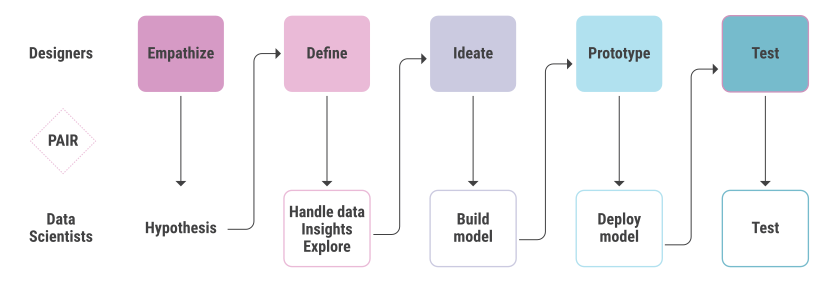
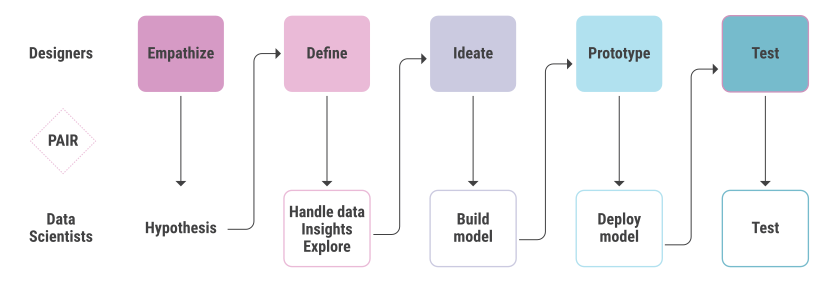
The Empathize & Hypothesis stage is where designers, engineers, and data scientists collaborate to:
- Understand user needs deeply
- Assess AI’s potential to enhance user experience
- Identify key opportunities where AI provides unique value
- Develop initial hypotheses about how AI should function
This phase relies on qualitative and quantitative insights to inform AI development, ensuring that technology does not dictate design but rather serves as an enabler of better human experiences.
Key Design Goals for Empathize & Hypothesis
To create user-centered AI solutions, teams should:
- Engage in User Research: Conduct qualitative interviews, surveys, and ethnographic studies to understand the motivations, pain points, and workflows of target users.
- Apply Design Thinking Techniques: Use methodologies such as Jobs-to-be-Done (JTBD) and User Journey Mapping to contextualize user challenges.
- Leverage AI Ideation Frameworks: Use tools like:
- AI Design Sprints to rapidly prototype AI concepts.
- AI Prompt Card Decks for brainstorming AI use cases.
- AI Canvases to visualize potential AI applications and associated risks.
- Assess Uncertainty & Risk: Categorize AI-driven decisions into levels of uncertainty to mitigate risks early in the process:
- Low uncertainty → Low risk
- Medium uncertainty → Some risk
- High uncertainty → High risk
Pairing Designers with Data Scientists
A significant shift in AI development is the close collaboration between designers and data scientists. This partnership ensures that:
- Designers bring human insights to data science models.
- Data scientists align their models with real-world user needs.
- AI solutions are designed with a balance between automation and augmentation.
A notable example of this approach is IBM’s AI Fairness 360 Toolkit, which helps designers and data scientists detect and mitigate biases in AI models collaboratively.
Optimizing AI: Precision vs. Recall
When developing AI models, teams must decide whether to prioritize precision or recall:
- High Precision → Reduces false positives but may miss relevant cases.
- High Recall → Captures all relevant cases but may include false positives.
For example, in a medical diagnosis AI, it’s more critical to prioritize recall to avoid missing potential cancer patients (false negatives). In contrast, for fraud detection AI, prioritizing precision may be better to prevent blocking legitimate users.
Using frameworks like the Google People + AI Guidebook, teams can design reward functions that balance these trade-offs effectively.
Stage 2: Define
In the Define phase, teams refine the problem statement based on insights from Stage 1. This phase involves:
- Synthesizing research data to define user pain points.
- Creating personas to represent user types.
- Developing a problem statement that captures the core challenge AI aims to solve.
- Identifying AI opportunities within constraints like ethical considerations, feasibility, and regulatory compliance.
A clear problem definition ensures that AI solutions remain focused and impactful, preventing scope creep.
Stage 3: Ideate
The Ideate phase encourages brainstorming multiple solutions. Methods used include:
- Storyboarding AI Interactions: Mapping user journeys to visualize AI integration points.
- Sketching AI Workflow Models: Conceptualizing AI behaviors and outputs.
- Using AI-Specific Brainstorming Tools: Google’s People + AI Guidebook provides frameworks for AI-specific ideation.
Teams should generate diverse ideas before narrowing down the best solutions based on feasibility, user impact, and ethical considerations.
Stage 4: Prototype
The Prototype phase involves creating tangible AI-powered experiences. Approaches include:
- Wizard of Oz Testing: Simulating AI behavior manually before full-scale implementation.
- Low-Fidelity Mockups: Using tools like Figma or Sketch for early UI/UX prototyping.
- Building AI Proof-of-Concepts (PoCs): Developing small-scale AI models for usability testing.
Rapid prototyping allows teams to validate AI assumptions early, reducing development risks.
Stage 5: Test
The Test phase ensures AI aligns with user needs through:
- User Testing with AI Prototypes: Gathering real-world feedback.
- Bias & Fairness Audits: Using tools like Microsoft’s Fairlearn to detect biases.
- Iterative Refinements: Improving AI interactions based on testing insights.